



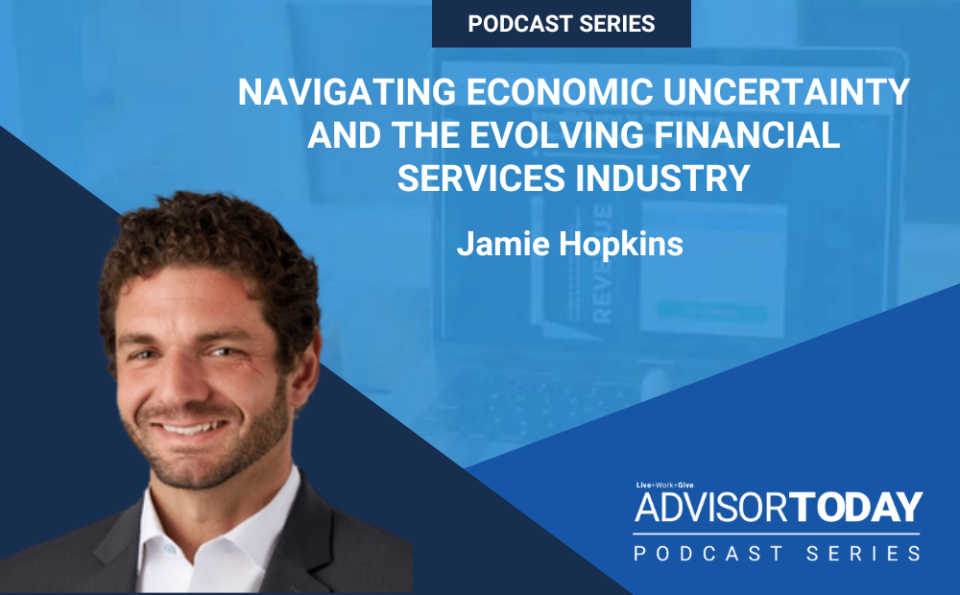
Jamie Hopkins is the Executive Vice President and Chief Wealth Officer at WSFS Bank, where he leads the wealth management segment, providing private wealth and trust services to clients through both WSFS Bank and Bryn Mawr Trust. Under Jamie's leadership, WSFS and its associated entities have served clients for over a century, and he has contributed to the financial services industry as an author, educator, and by helping launch over 700 FinServ Foundation fellowships for students.







Here’s a glimpse of what you’ll learn:
- [03:20] How Jamie Hopkins transitioned to leading private wealth and trusts
- [07:36] Why inflation is a 30-year challenge, not a yearly one
- [10:05] Why home prices remain high and inventory stays low
- [14:04] The “golden handcuffs” effect of low mortgage rates
- [17:40] How tariffs and material costs are impacting home builders
- [19:24] Jamie shares his insights on the future of commercial real estate and conversions
- [22:31] The real impact of recent estate planning legislation
- [28:13] Jamie’s new book about transforming retirement planning into visual learning
- [37:14] Why technology and AI won’t replace advisors anytime soon
In this episode…
From inflation and interest rates to housing market stagnation and evolving tax policies, uncertainty seems to be the only constant. How can financial professionals stay grounded while guiding clients through such unpredictable terrain?
According to Jamie Hopkins, a nationally recognized financial educator and thought leader, the key lies in maintaining a long-term perspective amid short-term noise. He emphasizes that inflation is not a one-year issue but a 30-year concern, urging advisors to focus on sustainable financial habits rather than chasing short-term fixes. Jamie highlights that while higher costs and stagnant incomes squeeze Americans, strategic estate planning, diversified wealth management, and proactive communication can help restore confidence.
In this episode of Advisor Today, Chris Gandy sits down with Jamie Hopkins, Executive Vice President and Chief Wealth Officer at WSFS Bank, to discuss navigating economic uncertainty and the evolving financial services landscape. They explore inflation’s long-term impact on client behavior, the state of real estate and interest rates, and how AI is reshaping advisory work. Jamie also shares how education, trust, and technology can prepare advisors for the future.
Resources mentioned in this episode:
- Chris Gandy on LinkedIn
- NAIFA
- NAIFA National Leadership Conference (NLC)
- Zack Huels: LinkedIn | Email
- Jamie Hopkins on LinkedIn
- WSFS Bank
- Bryn Mawr Trust
- Your Retirement Sketchbook: 125 Retirement Planning Lessons from Financial Experts by Jamie Hopkins and Bonnie Treichel
- Find Your Freedom by Jamie Hopkins and Ron Carson
- Holistiplan
- Trust & Will
- Wealth.com
- Vanilla
Quotable Moments:
- “Inflation is not a one-year problem; it's a 30-year problem.”
- “Prices aren't coming back down, right? Like that's not a story with inflation.”
- “Americans are concerned about this in mass, although it's not everybody.”
- “People’s money problems are more complicated than they’ve ever been in the history of the world.”
- “It's hard to bet against technology in the long run, but I think we're vastly overemphasizing the impact that AI is having on the short run.”
Action Steps:
- Reassess long-term financial plans: Reviewing strategies with a 30-year lens helps clients stay resilient through inflation and market shifts.
- Strengthen client communication: Maintaining consistent, proactive outreach builds trust and eases client anxiety during economic uncertainty.
- Expand service offerings: Integrating tax, estate, and insurance planning provides clients with holistic solutions and strengthens advisor value.
- Embrace technology strategically: Using AI and digital tools for efficiency allows more time for meaningful client relationships and guidance.
- Prioritize continuous education: Staying informed on policy, tax, and economic trends ensures advisors can deliver timely and informed advice.
Sponsor for this episode...
This episode is brought to you by the National Association of Insurance and Financial Advisors, or NAIFA, the #1 association for producers in financial services.
At NAIFA, we enhance professional skills, promote ethical conduct, and advocate for legislative and regulatory environments.
By joining NAIFA, you gain access to a partnership that elevates your performance while providing greater purpose to your professional work. NAIFA members are happier, make more money, and stay in the business longer.
Get in touch with NAIFA and learn more about how to join NAIFA by visiting NAIFA.org.
EPISODE TRANCRIPT
Intro: 00:02
Welcome to NAIFAs Advisor Today podcast series, where we focus on how financial advisors work, live and give to their local communities and our greater financial services industry. Now let's get started with the show.
Chris Gandy: 00:20
Hi everyone. Welcome to Advisor Today, the podcast where we give you back the voice of the advisors and what's happening out there in the insurance and financial services world. I'm without my co-host today, Joe, but I do have still in my back office, Zack Huels. Zack is behind the scenes making things happen. So I will announce our sponsor for today's program and it's none other than NAIFA itself.
Right around the corner is NLC National Leadership Conference, where we actually sit down and talk about how to become a better leader within the organization, within the industry, and also within your community, so don't miss out on a 2025 NAIFA Leadership Conference happening in Arlington, Virginia, October 14th and stay around for the Belong awards and the awards, and watch as your favorite people get sworn in and actually take their seat into the next role of NAIFA for 2026. Don't miss your opportunity to be a leader and show up at the National Leadership Conference. With that being said, I have the pleasure of introducing one of our I wouldn't say regulars, but at least someone we've had on the podcast before. You might see him on TV. I don't know if he's done a Ted talk podcast.
He's all over the place. You see him here and there. If you follow him on Instagram or social media, Jamie Hopkins, we're happy to have you. Jamie served for a period of time as a consultant and on our board for a period of time. And Jamie now has is transitioned into a different role.
So we look forward to hearing from him some of the things that he's doing. But an author and subject matter expert and also a writer of content and also education. So those who don't know Jamie helped with the our ICP designation through the American College and help coordinate that and put that on. So Jamie, with no further ado, welcome to advisor today the podcast. Good to see you, bud.
Jamie Hopkins: 02:28
Good to see you too, Chris. Yeah as as you know, we'll miss him today. Last time I was with him actually, we got some barbecue. So no barbecue here with us today, but thanks for having me on. I said, you said regular, but then I was trying to think of a witty thing, so I was, like, regular, but not ordinary.
So we'll go with that.
Chris Gandy: 02:47
Regular but not ordinary. I like it, I like it, I like it so. So, Jamie. So tell us what's been going on in your world. We noticed I've noticed that social media a little bit is that, you know, there's been some kind of changes career wise.
And but I still see you giving advice and talking about just topics that are top of mind for people as the economy continues to evolve and change. So share with us a little bit about your journey and kind of where you are now and and kind of what's going on in your space.
Jamie Hopkins: 03:20
I love this industry, and I think I'll always try to give back, give advice and be part of it forever. And yes, a couple things changed with me over the last two years. I stepped out of my previous firm and came over to Bryn Mawr Trust and Westfest almost two years ago now, and came in here to lead up our, you know, private wealth and trust teams. And it's been a lot of fun. And, you know, the trust side we get to work with NAIFA members often is we do a lot of delegated and directed trusts.
So where we act as a corporate trustee and somebody who's managing an eyelid, a legacy trust, and then look for us to be that trusty partner. So that's been that's been really fun as you kind of look out there in the world today, I think the the growth of high net worth individuals has been pretty pronounced out there. I do think we have a little bit of that, that tale of two cities going on where we have a good portion of America that is struggling with inflation and struggling with keeping cost of living adjustments up on their income. And then we've got another side of, you know, we have a tremendous amount of wealth and growth of firms here in the United States. And, you know, what we try to do is serve both of those ends.
But on the trust side, it really comes in on that more high net worth individual world. So that's been a lot of fun. It's a wonderful team. Bryn Mawr Trust has been around for about 123 years and is, I think, turning 194 years old here, coming up soon. So the city of Wilmington in Delaware, right.
The first state we actually predate, the city of Wilmington, which is pretty wild. It's my fun fact about the organization. So a long time of doing this type of trust work. You know, family's been good. I made a I made this change a bit to get off the road, although I travel a little bit, but way down from where, you know, I used to be a constant road warrior out there with you, seeing you everywhere.
But I will see you here coming up soon. So I know we're going to cross paths in this next month, but yeah, then I, I sit there at Fencer Foundation. We're up to about 42 colleges and universities that we work with, and we just passed our 700th fellowship granted out there to college students entering this industry. So that was, you know, really, really exciting. I actually sent the last email to that one that tipped us over 700 while we were sitting on the zoom before we got going.
So that is breaking news here. And then Bonnie Treichel, who's another industry leader, and I just finished up a new book called Your Retirement Sketchbook. It is out there on pre-order now, so if you feel like getting one and then hopefully I'll pass all of you at a conference at some point at any event and get that signed for you too. But that's a little bit of what's been going on, Chris. Obviously, there's a lot of things going on in the world, but those are kind of the good career and fun industry oriented things that are going on in my life.
Chris Gandy: 06:08
So, Jamie, you know, people are always interested in your perspective. So I want to ask some some common topics that I think maybe on other people's minds. And we just like to hear kind of your insight, your thoughts, even though again, these are opinions, these are not necessarily financial advice. This is just opinions. These are thoughts.
These are Jamie Hopkins perspective. But I think you have an offer you typically present in a little different lens for people. And you have credibility. Right. And so the first topic I want to to approach is inflation okay.
Is that fair. Is that an okay topic? we see. So so let's talk about what we see and what's real and what's not right. And so we see that inflation's super high.
And we see that there's pressure on the fed chair to make some adjustments make some changes even prior to where he may feel comfortable of doing so whether good bad or indifferent. Right. So share with us a little bit about what are your thoughts around inflation, what's happening and what could happen as we move towards the future if we keep reducing potential interest rates, however, it's not warranted or whatever it may be. Yeah.
Jamie Hopkins: 07:36
Yeah. One thing I've always said about inflation is that inflation is not a one year problem. It's a 30 year problem. So what we do feel inflation short term right. Prices go up.
You see them. You get stressed out. You might have less disposable income in the near term. Really, it's the long term implications I always worry more about with inflation. One of the reasons is when you think about inflation, the kind of watching the monthly numbers is important because the Fed's always trying to get ahead or slightly behind, right?
Trying to be fast followers of what the data is telling them. The reality of inflation is that I see people saying, hey, when are price is going to come back down, prices aren't coming back down. Right? Like that's not a that's not a story with inflation. Even if inflation gets to a very modest 2% a year type of inflation run, that permanent cost of inflation that has occurred the last two and a half years is still there.
So now we just have elevated prices rising at maybe a slower rate than they were a year and a half ago. But we're unlikely to see this deflationary aspect in any broad measures. You might get certain areas where, like milk can spike and come back down, eggs can spike and come back down, you know. Gas does fluctuate based off oil and demand up and down. But like long term, these things are still moving up and to the right.
Unless there are massive government subsidies that are kind of offsetting that cost of the goods from a long term perspective. But generally speaking, right, we're going to continue to see things go up, not really come back down. So where are we today? Look, I think all of us agree that the last couple of years we had high inflation. There's not a lot of argument about that where inflation is sitting at the end of 2025, a little bit debatable.
I would actually argue I think inflation is actually not that bad right now, with the caveat that stuff's expensive and discretionary income has been shrunk down because things grew faster than people's income were. So it's tighter for a lot of Americans now. That's a reality that is different than is inflation out of control? No. But I do think people's ability to maintain their livelihoods is being really, really challenged right now.
And that's the thing that I'm more worried about than exactly is inflation 2.42.6. Yeah, that's that's in a safe range. I mean, historically in the US we've been over three for like 100 year time period. So in under three to me is a managed inflationary world. But it's challenging when you felt that run up in the last couple years and income didn't keep up with it.
And all of a sudden you're seeing, you know, home prices still very elevated, very hard for a lot of Americans to buy homes, maintain their homes, buy food. I think that's a very scary proposition. Now where the fed is landing is they've been saying for a couple of years they've got a dual mandate, right? They've got jobs and they've got inflation. They want to get inflation down to two and keep jobs in a healthy spot.
I'd say the bigger concern lately was that jobs have not looked as healthy as we thought they were going to be, especially that revision where we lost almost a million jobs, lost in the sense of the data. Right? The revisionary back look said, hey, there's probably about a million that did not occur. I think that's a scary proposition. Also, when we're facing this AI and robotics boom out there that is expected to replace some jobs.
And so we've got this momentum coming out of a technology advancement displacing potential workers. You know, still overall in a healthy I'd say unemployment rate, but getting worse and inflation may be ticking up. And then you've got this concern out there. And I'd say Americans are concerned about this in mass, although it's not everybody. But what's the impact of tariffs if these really hit full on right.
We're still waiting on China to kind of see and that'll probably ebb and flow for a while. But where does that impact really land. That's going to be a driver because if all the tariffs end up pulling through, at least for a short term period, it will be inflationary. I don't think there's much argument about that. The arguments typically over a long term, is it inflationary or not.
But short term tariffs will drive some inflation and prices up. I mean that is we've already seen it pull through. People are feeling it today. They're noticing it. And that could still get worse here over the next couple of months.
Chris Gandy: 12:05
You know Jamie I've noticed there are clients that were high in clients and they're now looking for jobs, right. That they figured that my job would be here. I've also realized that there were people during Covid that mismanaged the flexibility and the fluidity of money. Right? And so it was that the belt was looser and people were able to make more decisions.
There were more bonuses being paid out. There were companies getting underwritten by bye bye forgivable loans, and it was it was more fluid, capital wise. And so the fluidity is tight. And so people are having to make different decisions. So I ask you just in your observation, with home prices being where they are, which are high, no inventory, which is interesting in the city of Chicago.
The interesting enough, I work with a realtor. They said that in the city of Chicago in in last month there was there was only 800 sales in the city of Chicago, which is like unheard. Like it's just unheard of in the city of Chicago. Right? Okay.
So that that tells me that that if there's no inventory, home prices are still high. People's income is the same, but everything outside of the mortgage costs more. Are we sitting in a situation where we potentially could see another influx of of homes being short, sold and foreclosed? I mean, right now you think you think about it. It's when was the last time you heard of a short sale?
Right. It doesn't. Right now it's it's not a thing. Right.
Jamie Hopkins: 14:04
And so they're not really out there right now. So, one of the things is not really I mean, that's a really interesting thing, is that when you look at most of the data, what happened is people locked themselves into those low interest mortgage rates, and then housing prices surged. And we actually have a lot of those people. What you're seeing is they don't feel like they can move. We kind of, you know, there's a little bit of joking going around that it's like a 30 year golden handcuff because you got inflation higher than your mortgage rates now.
And all of a sudden you look at that and you say, well, like why would I ever sell this thing then? right? Like, I've got a better instrument here from a lending perspective. Then I, then I, then I probably should have in today's environment. Right.
Like you can go get a 4%, you know, CD or something today and you're borrowing at 2.75. Well that's great. Like I should do that every day. All day, right? If I had an infinite amount of money, you just lock in as much of that as possible.
And so that's a little bit of what's going on out there. There are not a lot of people who have bought or refinanced at the higher rates in the total macro market. So you still have most people operating off of a lower home value with a lower mortgage, with really low interest rates. Kind of what's happened before we've had this is people buy into it at high rates, at high prices. So if we started seeing today, Chris, that all of a sudden it went from a couple hundred to 10,000 people buying homes with high rates at high prices.
I think that could lead us to there. But I actually think what's happening is people don't see the economic trade off today, that they have a good mortgage, probably a decent home that's gone up in value. And then when they look around to go buy a similar house, it might be doubling their mortgage payment to go into a similar house today with more cash up front. And I just don't think that proposition is interesting to a lot of people. And to me, that's what's going to hamstring this supply.
And you also look at builders. Here's another issue. And this isn't builders fault. But like people aren't building affordable small homes anymore. Right.
Like that has been a prolonged issue. You probably drive around right outside of Chicago. Nothing's a starter home. Nothing's three bedroom, one bath. Right?
It's all like seven bedrooms, 16 bathrooms. And you're like, wow, why? So many, like, our families, are the smallest they've ever been. And the house has got to be larger than they've ever been like. And I kind of look at that and I'm like, you know, like starter homes back in like the 60s, 70s and 80s.
I mean, they barely fit the households then and today, you know, we have 1 or 2 kids on average and houses have five bedrooms and there's some misalignment there that is going on. And but I do think that that is holding us back from having more of this supply come in. But that's just the economics of where real estate is today too. It's expensive. So people are building bigger, nicer houses on expensive real estate.
Chris Gandy: 17:01
But Jamie, on the same topic, goods cost more, right? And so I know some builders that are building and they're saying, like, we estimated that we were going to be able to build this house for a million, one, 1,000,002. And they're coming in now with especially with the tariffs and a lot of the material coming from outside. They're coming in closer. They're saying like 30, sometimes 40, 50% over by the time the project is done.
So what should someone do if they're in the process of building right now because it's, it's it's a checkbook with with with endless with, you know, with endless question marks right now. So so what do they do?
Jamie Hopkins: 17:40
Yeah. At work. So here at Wsfs, we lend a lot to that middle market construction, real estate. And what I mostly hear today is people are going to finish up the current projects that they're working on, right? They're going to finish their bills, they're going to finish their neighborhoods.
But the question mark is remaining about what's the next project. And so that's really what we're hearing from an economic standpoint, is it feels like the current projects are all going to wrap up. You know, you do remember those time periods to driving around, right? In the late 2000, early 20 tens with just stalled out neighborhoods that never got finished right. They got framed up and they just abandoned them and walked away.
You know, I don't expect to see that right now. It feels like these are going to get done. Profitability might get pinched a little bit right on the back end here. But I do think they're going to get done. The question is, is there enough kind of juice, for lack of a better word, in the next project?
Is there enough margin there for some of these places to move forward with them? And I think that's really undetermined. You know, early next year we could really see a slowdown in activity around that. Again, I keep putting that that hedge on the the tariff market is very, very fluid as we know. Right.
It's a daily fluid conversation with multiple countries and agreements right now. And as that plays itself out, if it gets better and later and more certain by the end of the year, I think it'll open up some of those commercial builders to say, hey, we're going to continue forward with the next project.
Chris Gandy: 19:16
But, Jamie, what happens to the commercial buildings that exist that are still 60% empty? Right? I mean.
Jamie Hopkins: 19:24
Yeah, I think that is starting to turn a little bit, although it is location wise. I mean, you're seeing some large firms say, get back in, right? Like, I mean, that is happening. And part of it, I think, is being done. You know, people made big investments into these places years ago.
They want to see a return on that. They want people back in the office. It's not occurring in every spot. But we are kind of seeing that monthly trickle back in still into the office. I think it's the ones that are a little bit more concerning from what I've gathered, is it's actually not so much the the city proper ones.
It is the, you know, we really moved to those suburban commercial spaces for a bit of time, and those seem to be struggling to get people back in because they don't necessarily have the same like community stuff to do. So if you look at the cities, their occupancies are starting to trick up, although things are still going into receivership and default in some cities, but it doesn't look as scary there. I think some of those other builds that the spaces maybe don't fit the world anymore. The multi tenants can be a little bit of a challenge. So people are looking you know for you know you know for changes there I'd say on both sides of the house.
And you know that is something we have to see over the next couple of years. The one good thing I went to an economic presentation around this, though, is one of the things that is holding a lot of those from seeing a lot of foreclosures and receiverships again, goes back to the fact they were able to lock in pretty low rates for most of those builds. Right? So you think a lot of those builds that got done in 2000 and 809 and then people didn't go in? The good news is they had really low rates.
If you were looking at that today and those builds, we'd be in a much worse spot because again, those those payments would essentially be double if they weren't getting filled. So that's helped some people manage those. And then you're seeing that conversion, I think in that space to to more mixed residential. So what you're driving around, you're seeing, right? People convert some of those commercial ones to apartments, restaurants below.
And so there's a little bit of a shift going on, I think, in how those might be repurposed if the office doesn't fully return.
Chris Gandy: 21:43
Let's shift gears. State planning the big beautiful bill passed. Good, bad or ugly? Is there any comments, any thoughts around that of like, okay, here's kind of some things that were really good in it, and here were some things and not so good. And how does that affect our estate planning?
Because obviously we understand that the limits are still there and they they've been extended. So, you know, if I have an estate of a certain size, I'm fortunate enough that it did not go back to where it was. But talk to us a little bit about a couple of those topics. Let's, let's, let's let's start with the big beautiful bill. Any any comments on it.
Jamie Hopkins: 22:31
Yeah. So a couple comments as it relates to the estate planning, which is really the big beautiful bill is much ado about nothing as it really relates to estate planning. The really big things we were thinking about, I mean, there were proposals getting there towards the end of totally eliminating the estate tax didn't didn't pull through. Right. You had other provisions of bringing it back down to a much more meaningful tax level.
And that's really the the reason that you might see that even though I'd say the the Republican leadership group is not a big fan of the estate tax, it does kind of, from a economic accounting perspective, really help fund things in a bill. So like eliminating it's really hard because where do you come up with the revenue. And that becomes the challenge in the bill. So you saw it extended out a little bit to your point broadened a little bit, but I think number of people impacted by that is a relatively small group, because we were already talking about a very large lifetime exemption amount and a state exemption amount being expanded up a little bit. Total number of people.
Not a huge impact. I've made this argument for a long time and it's a fairly unpopular. So if I became a politician and ran on it, I'd have to come up with a different way to propose this. But I'm a big fan of the estate tax, always have been, for two reasons. One, I've always asked myself if I was going to pay taxes in my life when I would.
When would I rather pay them? Would I rather pay them now, today? Or would I rather push them off in my state? Pay them? In short, I would rather pay every tax I'd ever owe in life, at my estate, at my death, and none during my life.
So that would be my choice. And like, could you do that? It'd be almost impossible to move the current system to that. But yes, of course you could. Right?
You'd either spend the money or gift it, which would be taxable in the same In situation or paid at your death. And actually, if you think most people, if you really understood that concept, would agree that I would rather pay my taxes at death. Right? I'm not in ancient Egypt. I'm not bringing my money with me in the afterlife like it's gone.
So what? Did I pay taxes at the end of my life? So I'm actually kind of a fan of generating some of our revenue at death instead of having to pay income taxes every year. It seems like a lot of wasted energy and efficiency. The other thing is, I'm a big fan of the estate tax because when the estate tax was lowered, guess what?
People did more of Chris. Guess what they did right? Or the exemption?
Chris Gandy: 24:57
More life insurance. We bought.
Jamie Hopkins: 24:59
We bought more. We actually bought more life insurance and we did more estate planning. As the exemption amount has moved up, we've seen less planning, less, less gifting, right. And less life insurance. And it's directly tied to that because most Americans now look at that and say, I will never owe estate taxes.
I don't need liquidity, I don't need to do planning. But when that tax impacts more people, we get more planning. So from my perspective, the tax serves as a functional, hey, go get your work in order. So I actually don't like it seeing it push back. Now look the other argument is less like an estate tax at all.
People shouldn't pay stuff at their death. Different argument, but when I look at it from a behavioral standpoint, I see the value in it. So I'm generally not a fan of moving it back. Total impact on this from like a dollar. It's not real significant, but that's the big one.
That really kind of came through from a state perspective that I've been talking about. So what does that mean? It means the onus to get Americans to think about estate planning is still on us. It's on the advisors, it's on the insurance agents, it's on financial service professionals. We are the ones that have to have that conversation.
And while it's never named that way in the bill, they should write that in there. Right? Since our estate tax exemption is so large advisors, you need to go do your job and make sure people know that estate planning is important. That's basically what the bill is telling us, right? The onus is not on the individual because of the tax.
It's on us. So I think that's really important for us to understand that what we do as a noble profession and making sure that people's heirs and kids and grandkids and kids with special needs are taken care of is super important.
Chris Gandy: 26:36
Yeah. You know. It's funny. You lower the exemption. People do more planning.
You raise the exemption, people do less planning. It's kind of backwards. It's like kind of an oxymoron, right? What are what are people doing? So what?
So what's new? So. So I know that you wrote you've written this is your is this your third book?
Jamie Hopkins: 26:57
Yeah. In a way. We'll go with third. You know, I technically have eight books, but some of those are textbooks, you know, so when you're going through American college courses back in the day, you're picking up one of those lovely textbooks. But yeah, I had retirement.
Two editions of that Find Your Freedom and then Your Retirement Sketchbook with Bonnie Treichel is coming out with Harriman House here pretty soon.
Chris Gandy: 27:18
Okay, so so talk to us a little bit about the the new book that's coming out. What can people look forward to? Is it is it a you know, it sounds like it's a way for people to engage into a process where, you know, when you when you say the word workbook. Right? It's it reminds me of going back to first grade where.
Jamie Hopkins: 27:45
Yeah.
Chris Gandy: 27:46
You learn something and then you have to have your workbook where you have to actually do it yourself, and then it keeps you on track because it's got like a little checklist of things along the way. So I could be wrong. But tell us a little bit more about the book. And for our members out there who are Jamie Hopkins followers and that believe in what you say, and actually some of the things that you the way you present us, where can they get this book?
Jamie Hopkins: 28:13
Yeah. So the book's hopefully going to really resonate with people. So it is different than anything I've worked on before, and a lot of people see my funny little, you know, videos where I write on the white paper. It actually got inspired by that. So the book is really following the whole continuum of saving for retirement, retiring spent, you know, retirement income planning, spending and retirement.
And then what happens at death? So we do this whole kind of story arc of retirement in the book. And so it follows those phases of, you know, saving, preparing, going into retirement, spending down and then passing away. And it's 125 different retirement planning topics, which is really cool. Then every topic is about that topic.
So Medicaid spend down. I'll just use that one. It's right on the top of my head. So we kind of describe what it is, some facts around it, a reflection question to your point. And then with the sketchbook part though that's really cool, is we actually did a drawing for every single one.
So you think of like sketch art where somebody is talking and they draw the little sketch of it. So every page is an explanation, reflection, question, advice on the topic, and then a sketch page of visually drawing out what that concept really means to you. So many people are visual learners. And so our goal was, hey, let's tie this retirement planning concept to something that people can more easily and hopefully more fun, you know, kind of interact with. Then to your point, we have these blank pages where people can do the reflection questions and actually draw some of the concepts for themselves, like how do you turn this concept of Medicaid spend down into a picture?
Those an individual years ago that told me, write anything that you can explain, you can put into a picture. And I thought that was such a cool idea. So I said, let's do that. So we did that for 125 different retirement plan topics, including things like life insurance, islets, reverse mortgages, all these fun topics that we talk about all the time. But let's show them, because I feel like for us, the only thing I ever see is like bucketing, right?
And you just see those three buckets pouring one to another. That's like our number one visual in this industry. So I was like, let's make a whole bunch of these. And yeah, that's the book. Easiest place is always Amazon.
Although you know, it's at Target and Walmart and Barnes and Nobles for preorder. But I think I think everybody just goes on Amazon and your retirement sketch book and you can preorder it today.
Chris Gandy: 30:33
So, Jamie, will it be a tool that people like simplistic people like myself can say, okay, here's how they explained it. Maybe this is a way I can explain it again in a different situation. Or is it something where I'll learn it myself, but I can't articulate it to a potential client?
Jamie Hopkins: 30:53
Now we are hoping that this becomes like an advisor tool that advisors will use. Hand out, give the clients. We're actually approaching some retirement plan providers too, about this being an education piece out to all the participants. While we haven't finalized this portion yet. We will do it.
We're just not sure we're going to do 125 of them, but we actually plan on doing flash cards with each topic. So taking the drawing and making it the back side, I don't think we'll do a whole 125. We're probably going to get it down to about 50, but we think that'll be a really like kind of fun activity to to have that goes along with this.
Chris Gandy: 31:30
Nice. That sounds pretty actually. Pretty pretty cool. So so Jamie, what's next for you? I know that kind of the go.
Let me rewind the tape. The role you're in currently with this trust company to describe to our listeners like what role is it? Is it business development. Is it corporate relationships, is it education? Is it I mean, give us kind of an idea.
So when people see you, they're not approaching you saying, hey, Jamie, listen, I was thinking about this fund or this fund. What do you think I should do? You know, like, just.
Jamie Hopkins: 32:09
Yeah, I get asked a little everything. Chris and I love that part. You know, so my my job is right. I am I'm CEO of the, you know, wealth business here and chief health officer at the holding company. So I oversee seven different wealth business lines and you know so that's a little bit of everything.
You know, I spend regulatory business strategy a lot of time with who our partner companies are going to be, right. From tech providers to other wealth firms spending time with them. You know, because I came out of that side, I had somebody when I was we were looking we brought them on, as you know, we're servicing as their corporate trustee for all their trusts. And I remember the end of the conversation. The guy's like, hey, it's just he didn't know me.
And he was like, man, it really feels like, you know what it's like to be an advisor. It's so refreshing to talk to a trust company. I was like, well, I, I still registered advisor and do a little bit of that too. And he was kind of like blown away that we had that mindset. I think that's been a really wonderful part of being here is, you know, my experience with clients and sitting in those seats and then sitting, you know, kind of at the strategy level that we're designing things here with that end client in mind.
Like I always lead with that in our meetings. Right? Is what's the best interest of the client. What's that client experience, even if it's not our client. Right.
Directly. Like really our clients often are advisory firms or wealth firms or family offices and in, you know, or other businesses around the area. But their end client client experience is a reflection on us ultimately. So we have to think about things when we deliver product services, technology, you know, even communications out, you know, what is the impact on that end client. So, you know, I love this business.
Going to continue to try to grow this business and lead it into the future. And then yeah, the, you know, be part of the industry. I mean, I think that's an important thing for me is being this industry advocate and helping, you know, whether it's education, whether it's nonprofit work, whether it's work with the trade associations. That's really important to me, because I really do believe that the rising tide lifts all ships, and the more of us that are doing better work out there, the better off everyone is, because that drives the trust in this industry from Americans across the board.
Chris Gandy: 34:21
Well, I mean, and Jamie, give us some insight. I mean, the industry is changing, right? And, you know, I I've, I've been on the, you know, out there on podcasts saying I don't believe AI replaces us. I do believe that it can help us be more efficient and effective at what we do, because at the end of the day, when we show up to the funeral, imagine a bunch of robots showing up at a funeral saying, we're here to deliver checks. That just doesn't make sense.
But when it comes time to make really hardcore decisions, to have to deal with the heart, the the the intelligence can't do that, right? The intelligence can't come into the home and make dinner and have you sit at the kitchen table and you talk about nostalgic things. I mean, so those are things that will never go away because this is a business of this is a relationship business, right. And so the data free and clear. Sure.
I mean, it can make a lot of a lot of us, I believe in our businesses more streamlined and more effective and efficient. I'll give you an example. I was talking to a client the other day and he goes, Chris, I want to lean into AI. He goes, I want our some of our investments to have a heavy AI influence. And so I've got a couple research guys, but I just popped it while we're on the while we're on the phone, I was like, let me go to chat and let me let me pull up the top innovative, top five innovative AI funds out there or opportunity investment opportunities for clients to participate in.
Right. And yeah, how how much time would that have taken, you know, my young guy to to come up with an analysis of it. All right. However, it did not tell me like, well, if I'm building a portfolio and the assets are underwater, like, how do I recapture some of that? Like, so there's there's the Cape are capabilities that come from experience.
Right. Even understanding that inflation is changing and that because of just the economy and because of the dynamics of the politics today, that it can swing one way or the other, and us being aware of and being human and understanding. Okay. Let me watch this a little bit. Let me see what happens.
Right. It's not as driven by AI, but it's about we get a feel for it. And that's something that AI can't, you know, can't do. And maybe I'm wrong. It just hasn't evolved to that yet.
But I do think people that are not in this industry, coming into this industry, it's a great opportunity. And people that are in this industry that are running scared from it, I think they need to embrace it. And the people that are on their way out. I think they need to integrate it into their practice so they can they can sell their practice at a multiple versus a, you know, a flat rate. So what are your thoughts on on just the future of our industry and AI?
Jamie Hopkins: 37:14
I think our industry for the next decade, 15 years, is going to be one of the best stretches and runs to be in this industry. So I am, you know, really excited about that. I think we're going to you know, I think people's money problems are more complicated than they've ever been in the history of the world. And I think that suits this industry to come in there and marry that human element of it emotions, behavioral finance and investing together better than we've ever done it. I do think the technologies that are coming out there are allowing us to offer a better, broader service than ever before.
What I will say is it's hard to bet against technology in the long run, but I think we're vastly overemphasizing the impact that AI is having on the short run. I was on a panel, I think, a year and a half ago, and everybody on that panel said, hey, what's the single biggest thing that's going to impact the industry over the next year? Everyone said AI. And I said, that's nonsense. Like AI is not going to disrupt our industry that much for the next year.
It has not. Right. That's been a year and a half. And to be honest, like the best thing that people are doing is taking notes with AI. I mean, like, that's not disruption.
Like that's a that's an intern. That's just going to be honest. Right. Interns were doing that work, right. There are actually some really cool interns of note taking interns out there.
Like, that's not disruption, right? That's a little bit of efficiency on the sides of an advisor. That's great. But that has not disrupted anything. I really today say I haven't seen any AI disruption in our industry.
I don't think any advisor is losing their business to somebody down the street because of AI yet. Now, long term, do I think that's going to change? Absolutely. But I still don't think that's in the next two years. I still think that's maybe 3 to 5 years out when I talk to most firms, they're dabbling in AI.
They have some, you know, whether you know what some of those AI bots internally that's helping searching be better, drafting a little bit. All those things are little like slight efficiency gains at this point. The problem with AI those an Apple report in 2025 around this which said that AI is really good at single like single issue tasks. So go tell me the top you know performing AI companies from an investment standpoint. It can do that.
If you then ask it though like go find those, put them in a portfolio and create tax efficiency out of it. What happens on three layer complicated tasks is they actually go to an accuracy rating of zero. So Apple tested this across all of the the mass models out there. And not a single one got anything right. Because they're guessing.
And that's how those systems are created. So they're making an educated guess, but when you compound educated guesses three times, guess what? You get complete garbage, right? That's like when I tell my kids one fact, and then they extrapolate it twice and all of a sudden like, right, I say unicorns aren't real. And they're like, unicorns aren't real, but dragons are real.
I saw a dragon yesterday and like, that's how we got there, right? Like, is somehow right? Like, okay. Like we're really far off here. You know, that probably isn't a perfect example, but you get it.
Like you, you have kids when you tell kids one fact and then all of a sudden the same sentence, like, you're you're totally far away from this thing. And that's really what's kind of occurring to AI today. But that's going to get better and better the future. I don't even know that we can imagine what it's going to be yet. I do think it'll be disruptive.
But today, and I think for the next two years, it's about pulling other services into your firm. That is the main thing I'm seeing. Clients are saying we want one stop shop. We want to be able to do our banking, our investments, our planning, our Our insurance our state with you. So we saw tax services pop up the last three years.
More and more firms are using places like Holistiplan than ever before. You're seeing the growth of all the estate planning services from Trust & Will advertising at the, you know, on NFL games and in apps to wealth.com to Vanilla to all these places coming in, you know and that is what to me is being demand driven from the end client. We just haven't been able to deliver a coordinated experience well yet in this industry. But if we can do that over the next two years, if you look at the firms that are growing, they have more services than the firms that aren't growing as fast. That is one really big thing you can point at and say, well, they have more like they just have more.
It might not be a lot more expensive, but they're delivering more at the same cost structure and they're growing faster.
Chris Gandy: 41:41
So Jamie, really quickly, I found the book. It's called Your Retirement Sketchbook: Retirement Planning Lessons for Financial Experts by you and Bonnie Treichel. Is that correct?
Jamie Hopkins: 41:53
That's us. Yeah.
Chris Gandy: 41:54
That's you guys? Yes it is, it is, it is out. So it says retirement sketchbook 125. What is that 125 stand for.
Jamie Hopkins: 42:04
Well, that's the 125 different topics. I don't know I don't know how it's populated right now, but that's, that's the 125 different. So probably says if the yeah behind it. That's kind of the subheader. Right.
If you usually have your book and then that that one that's in small print underneath that you never bring up again.
Chris Gandy: 42:21
Okay. And Jamie, where can people find you now? I know you're online at places you can look up. I find you, but where else? I know you're going to be out in California at three presenting or three, four or E3, E4, E4.
Jamie Hopkins: 42:36
E3, E3. Yeah, I'll be at E3 and I'll be out at Schwab, impact and FPA National. I'm speaking at those here later this year. Really haven't thought much about 2026 where I'll be yet. But yeah, I'm sure I'll be hitting the circuit a little bit with the book probably early next year too.
Chris Gandy: 42:58
Well, Jamie, you know, it's always it's always good to see you. Do you have any other final words? I mean, I could go. I have like seven topics, but I think.
Jamie Hopkins: 43:08
It's a good time to wrap up the look. I think one of the things we we landed on here, though, is Americans are stressed, your clients are stressed. Stay in front of them. Keep communicating. Our job is to help them with peace of mind and their financial security.
Right. It's a noble profession, which I mentioned before, but there's never been a better time in the history of our industry to be in this industry, right? Finances are more complicated than ever, right? We have more people with money in our country than ever before. There's more wealth than ever before.
The tax laws and estate laws and services are changing more rapidly than ever before, with terrorists changing daily. Right? We can provide so much value. So to get in front of people, help them with this, get them real planning done with all the services like that is such an amazing place to be right now. So with all like the chaos that might be going on out there, I think have that pride in what you're doing.
And what we deliver as an industry is really, really wonderful.
Chris Gandy: 44:07
Well, Jamie Hopkins, you know, you never disappoint brother. You know, we're always happy that you're part of the family. So those of you that are listening out there, go check out Jamie's book Your Retirement Sketchbook: Retirement Planning Lessons for Financial Experts by Jamie Hopkins and Bonnie Treichel. You can find that. And as we close the podcast today, Jamie, nothing else.
Jamie Hopkins: 44:31
You sure that's good for today? Yeah. You know, stay safe and healthy. We had a good close there.
Chris Gandy: 44:37
All right. So so so Jamie congratulations on the book that's coming out as NAIFA for members. Go get it. Let's support our fellow NAIFA member Jamie Hopkins. And for anyone feeling overwhelmed by financial needs, shoulds or maybes, this book is a roadmap that reflects and sketches out an actual plan.
Instead of just dreaming about one. So thanks for joining us today, Jamie, and sharing your heart and helping people engage in, in their own terms. And to our listeners, go out there and grab the sketchbook to support. Jamie, listen, this is Chris Gandy. Thanks for listening to NAIFA Advisor Today.
We're belonging, believing and leading isn't just a mindset, it's a plan. Just like in the sketchbook. Until next time, stay curious, stay courageous, and keep building towards the life you deserve. We'll see you soon. Thanks.
Outro: 45:33
Thanks for joining us for NAIFA's Advisor Today podcast series. Make sure to subscribe to get future episodes, and if you're interested in coming on the show, let us know.



.png?width=300&height=600&name=Tax%20Talk%20Graphic%20-%20email%20tower%20(300%20x%20600%20px).png)
