



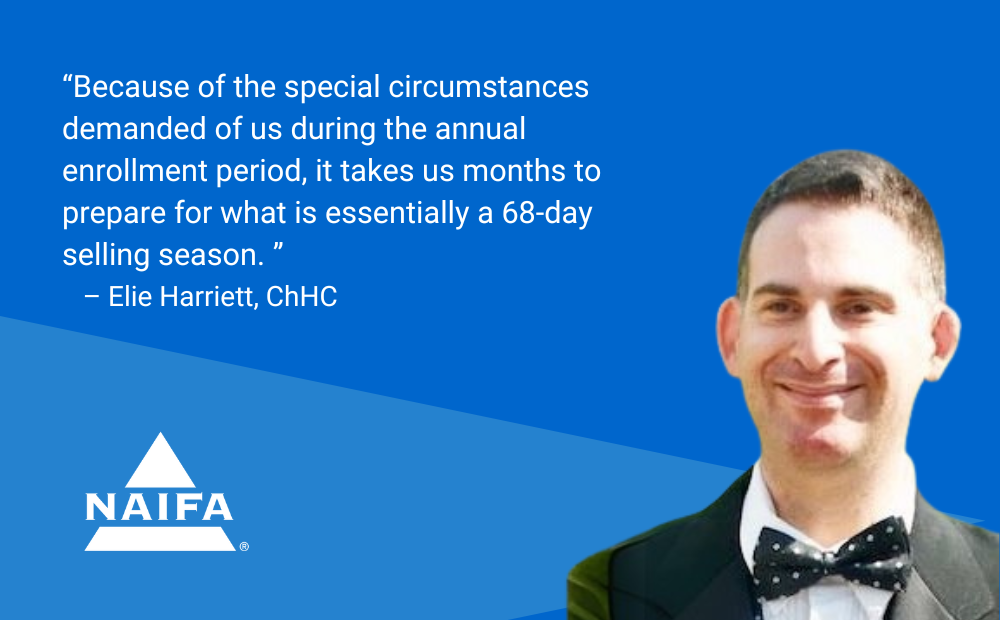
Because of the special circumstances demanded of us during the annual enrollment period, it takes us months to prepare for what is essentially a 68-day selling season. We are basically a normal health insurance office from January until June, and then beginning in July we start getting ready for October 1, the date we can begin speaking with clients new and old about their health plans for the following year. Here is what our office does:
July:
- Make sure the client mailing list is up to date. Multiple points of contact need updates: addresses, email addresses, and most especially phone numbers. The over-65 crowd can all use technology, but they do not all want to use technology, so we have to be prepared to meet the client on terms they are comfortable with. They all have phones and almost all have email. Make sure they’re updated. Pull any contact we’ve had with them in the last year and make sure there’s no new points of communication we are unaware of.
- Make sure the changes from last year are reflected correctly in this year’s client profile, and that clients are still in the plans they are supposed to be in. For someone that doesn’t do this on a regular basis, that seems like a pointless waste, but these days, accidental enrollments into unexpected plans are part of normal business, no matter how confident we are our clients would not intentionally move without us. We need to double-check and make sure everyone is where they are supposed to be.
- All agents doing the selling have to begin a certification process. Personally, as the years go on, we push this to the end of July and into August, but I understand the desire to get it done early. We push it into the next month for the test bugs to get worked out, errors to be discovered, and systems clear of traffic. Basically, each person doing the tests has to devote about a week away from business to get them done, and we want it to be as error-free as possible.
- There are two nationally accepted tests, one by AHIP and one by NABIP. AHIP is the more universally accepted one, but NABIP is accepted by most and is developed by agents and may be more useful, especially to new agents. Make sure you know which carriers accept which tests.
August:
- Check with your FMO on contract status with all carriers you plan to sell, AND see if there are any newcomers you wish to offer. This is another reason to do the certifications closer to August. Most new carriers announce end of July if they enter your area. You can get contracted with them, and then handle their certifications in a timely manner.
- Prepare a letter for your clients reminding them of the annual enrollment period. We do a physical letter due to the broad range of clients and the fact that so many live in rural settings. But email is fine if your clients prefer it. I’d avoid a phone call at this point simply because it could consume more time than you have once your client list gets large enough.
- Check your tech. Do it now. If you use a house recording system like we do (recordings of calls are mandatory), make sure it works and is compliant. If you do video calls, make sure the cameras all work. Make sure the computers you plan to use will work for the next year’s enrollment system. Do not make an assumption that the 2025 enrollment platform will carry over into 2026. Even if it might … it might not. Make sure whatever technology you need to use for enrollments is going to be compatible with the next year. If it changes, it will be a flipped switch. One day the existing platform will work and literally at 12 midnight the next day it stops. Don’t wait until that moment to find out you have a problem. Every company has its own enrollment platform, and many FMOs combine them for your ease of use. Make sure it is set for the next year. Also, do not forget Windows 10 is being end-of-lifed this year during AEP. Will that cause a problem for you? And Apple updates their operating systems in October. Try not to do any major computer updates in the middle of AEP unless they are absolutely necessary. Updates can break tech.
- Start attending seminars from your FMOs, carriers, NAIFA, anyone that can give you another opportunity to reinforce the biggest changes coming the next year and how the carriers you represent are responding to those changes. Your clients depend on you being able to tell them what the biggest changes will be. Only bother with seminars/webinars that allow you to ask questions. If it is a “listen only” webinar I wouldn’t recommend it. Too many other things to do.
- Prep your clients' drug lists, and if they have Medicare Advantage, their doc lists too. We physically print the lists on paper, but most people we know would rather do it digitally. There’s a number of reasons for a physical print and good reasons not to also, but it comes down to who is making the notes, the changes, and how updates are logged. Basically, at the end of the year, how are changes tracked? If you have a reliable system for that, use it. But we begin in August by having last year’s list at the ready in physical form.
September:
- Everything is done by now save one thing: contacting clients. They are all told in August they’ll receive a phone call from us in September. This month, we call and get an update. Also a scope of appointment whether it will be needed or not. This is not a sales call. Do not try to sell anything. Just get updates. Are they still taking drug A? What new drugs have been added? In MA, do you still see this doc/have any new ones? Any docs change locations? The point of this is to do the prep work now, so that in October, when the new plans are released, we have the info and can plug it in, making recommendations accordingly if necessary. It has the secondary benefit of double-checking with the client the next month, when it is time to make recommendations. How often do clients give us even more changes? More often than we’d like, unfortunately. Get the first pass done now.
- There’s a second reason to do the above now, if we make an initial contact with our existing clients a month early: we want to find out some things. Do they WANT to move, Supp to MA, MA to supp? Do they want to add dental, are they having problems with anything? Do they have neighbors or friends that need help and need to know they should give us a call? These are all things that are important to do now, because come October, everyone will be doing it and you’ll be rushed much more. If there’s any selling that does not need to wait until AEP (like changing a supplement or adding dental), put them on the calendar to talk with them this month at another time and get it done before October.
- Due to the removal of commissions on a lot of stand-alone drug plans, many agents are either automating annual calls or having the clients enter the info themselves. While we are continuing to evaluate this, the opportunities to both retain business and gain referrals have been too great for us to stop doing it. The end result, unfortunately, is drug plan enrollments are still being done, and we are working for free, but so far this seems to be made up for in high client retention, additional ancillary product sales, and many more referrals, offsetting a lot of the free work being done. Basically, our time is still being paid for, just by a different stream.
October:
- You’re off to the races! October 1st says you can talk about the new plans, but not sell them. We need every second of these 15 days to chip away the long client list. They were called last month to find out what changed. This month, we call back to let them know how their plans are changing and how the drug/doc changes affect that, making recommendations if necessary. How many need to move? With a few exceptions, the rule is 1/3 should stay, 1/3 could move if they want, and 1/3 MUST move. The one in flux is the group that could move if they wish to. In general, we prefer NOT to move people if we do not have to, but for varying reasons, some of that 1/3 make the move. Regardless, anyone who needs to move, we put in the pile to move. However your agency chooses to enroll people, they go into that group.
- This is known as the “selling” season for Medicare Advantage. But really, find out if you want to be selling or servicing. We do not actively want new clients during this period unless they come by referral or we spoke to them some other time during the year. Be wary of trying to get into an unknown lead program during AEP. From October – December, you are competing for an individual’s business with everyone else. We basically close our leads during AEP that we’ve been speaking with the other 9 months and always find time for new referral business. Leads generated during this period have not been highly effective, in our experience during the actual AEP.
November/December:
- Just be there for your clients. Enroll as necessary and have someone monitor those enrollments, especially as the final days approach. Once December 7 comes around, the job isn’t done. Clients are not set in the new plan until January 1. Make sure everyone lands where they are supposed to. Be prepared for a few surprises as applications can be rejected for one reason or another. Try to fix any problems that can be fixed before December 7.
Then, Happy New Year. Next prep time is only 6 months away!
.png)



.png?width=300&height=600&name=Tax%20Talk%20Graphic%20-%20email%20tower%20(300%20x%20600%20px).png)
